
How to Write a Linked-In About Section That Turns Views into Opportunities
- Arjun Madhav

- May 31
- 5 min read
INTERVIEWCRACK365 · CAREER BRANDING GUIDE

How to Write a Linked-In About Section
What’s inside: why it matters · a 5-step writing framework · ready-to-borrow examples · mistakes to avoid · a publish-ready checklist
SECTION 01 - START HERE
More Than a Box to Fill
Your LinkedIn profile isn’t an online resume. It’s your professional brand — the first thing people meet before they ever meet you.
And no part of that profile works harder than the About section. It’s where a recruiter, client, or future collaborator decides whether you’re worth a closer look. Yet most professionals leave it empty, or fill it with a flat line or two that says almost nothing.
That’s a missed opportunity. You get 2,000 characters — roughly a page — to introduce yourself, prove your expertise, and spark interest. Used well, that short space quietly turns curious profile views into real conversations.
This guide walks you through exactly what to write, the mistakes to avoid, and a simple checklist to run before you publish.

SECTION 02 - THE CASE FOR IT
Why the About Section Matters
Recruiters skim dozens of profiles a day. Your headline earns the click; your About section earns the action. Here’s what a strong one does for you.

• First impression - It adds context that titles and skills alone can’t — the story behind the bullet points.
• Searchability - The right industry keywords help you surface in LinkedIn search when someone’s looking for what you do.
• A professional snapshot - It shows not just what you do, but why you do it — and where you’re headed.
• A human touch - A little personality makes you relatable, and relatable profiles get remembered.
Think of it as SEO for your personal brand: part discovery, part persuasion.
SECTION 03 - THE FRAMEWORK
How to Write Your Summary, Step by Step
The best summaries balance personality with professionalism. Here’s a five-part structure that works for almost any role.

Open with a hook - Your first two lines show before the “see more” cutoff, so make them count. Skip “Experienced engineer with 10 years of experience.” Try something with a point of view: “I turn complex technical problems into products people actually enjoy using.”
Show your impact with numbers - Specifics beat adjectives. Swap “improved retention” for “led a product initiative that lifted client retention by 20%.” Milestones, awards, and published work all belong here.
Share what drives you - Employers and clients want to know what motivates you. Naming the problems you love to solve helps the right people see how you’d fit their mission.
Weave in keywords naturally - Work in the terms people actually search — project management, data analytics, content strategy — without turning it into a list. It should read like you, not like a tag cloud.
End with a call to action - Tell readers what to do next. Something simple works: “Always happy to talk product and fintech — feel free to connect or send a message.”
SECTION 04 - SEE IT IN ACTION
Three Examples to Borrow From
Here’s how those five steps come together for different roles. Use them as inspiration, then make them your own.
EXAMPLE · MARKETING “I help brands turn their online presence into measurable growth. Over the past six years, I’ve run campaigns that lifted ROI by 35% for leading e-commerce clients. My sweet spot is where creativity meets data — SEO, content strategy, and analytics-led decisions. If you’re working on performance marketing or brand storytelling, let’s connect.” |
EXAMPLE · SOFTWARE ENGINEER “I build scalable systems that make complex products feel effortless. My toolkit spans Python, cloud infrastructure, and machine learning, and I’ve shipped work that made existing systems 40% more efficient. I believe good technology solves real problems — and I’m always experimenting with tools that sharpen how teams build. Open to conversations on AI, cloud, and cross-team collaboration.” |
EXAMPLE · BUSINESS LEADER “Fifteen-plus years leading teams across global markets has taught me how to drive change that sticks. I’ve scaled startups, grown a billion-dollar portfolio, and kept strategy tied to execution. These days I’m most energized by coaching the next generation of leaders to build inclusive, high-innovation teams. If you’d like to talk growth strategy or leadership, let’s connect.” |
SECTION 05 - STEER CLEAR
What to Avoid
A great About section is as much about what you leave out. These are the mistakes that quietly cost you attention.
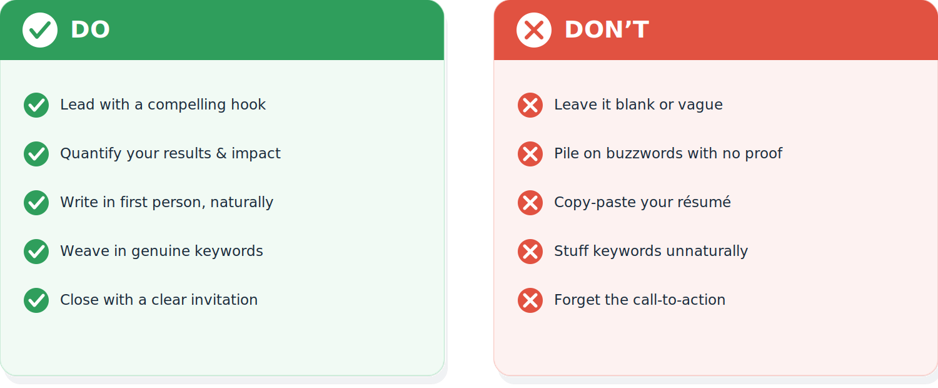
• Leaving it blank , or worse, vague - An empty About section reads as an unfinished profile. Generic filler like “hardworking team player” is barely better.
• Buzzwords without proof - “Results-driven,” “passionate,” “visionary” — words anyone can claim. Show the result instead of naming the trait.
• Copy-pasting your resume - Your About section is a story, not a duty list. Save the role-by-role history for the Experience section.
• Keyword stuffing - Cramming in search terms makes you rank for robots and lose real readers. Keywords should blend in, not pile up.
• Writing in stiff third person - “Jane is a marketing leader who…” feels distant. First person is warmer and sounds like you.
• Forgetting the next step - No call to action leaves an interested reader at a dead end. Always keep a door open.
SECTION 06 - GET FOUND
How It Affects Your Visibility
Your About section does quiet, behind-the-scenes work for your discoverability.
• Keywords drive ranking - Recruiters search by keyword, so the language of your industry helps you show up in the right searches.
• Good writing earns engagement - A summary that reads well attracts more profile views and connection requests.
• Completeness counts - LinkedIn rewards complete profiles, and the About section is a big part of reaching that 100% mark.
In short: a thoughtful summary helps the right people find you — and gives them a reason to stay.
SECTION 07 - BEFORE YOU PUBLISH
Your Pre-Publish Checklist
Before you hit save, run through this quick list. If you can tick every box, your summary is ready to work for you.

Pro tip : Read your About section out loud. If it sounds like something you’d actually say to a new contact over coffee, you’ve hit the right tone. If it sounds like a job posting, soften it. |
IN CLOSING
Your Professional Handshake
Your LinkedIn About section is far more than an optional field. It’s where your skills, experience, and ambitions come together into one coherent professional story.
Whether you’re job hunting, networking, or building authority in your field, a strong summary is what sets you apart. Aim for three things: clarity, authenticity, and value.
Get it right, and your About section stops being words on a screen. It becomes your professional handshake - the one that opens doors.
Comments